The Essential Role of Meaning in System Dynamics
Discover Meaning in Systems
Navigate the Interpretive Drift

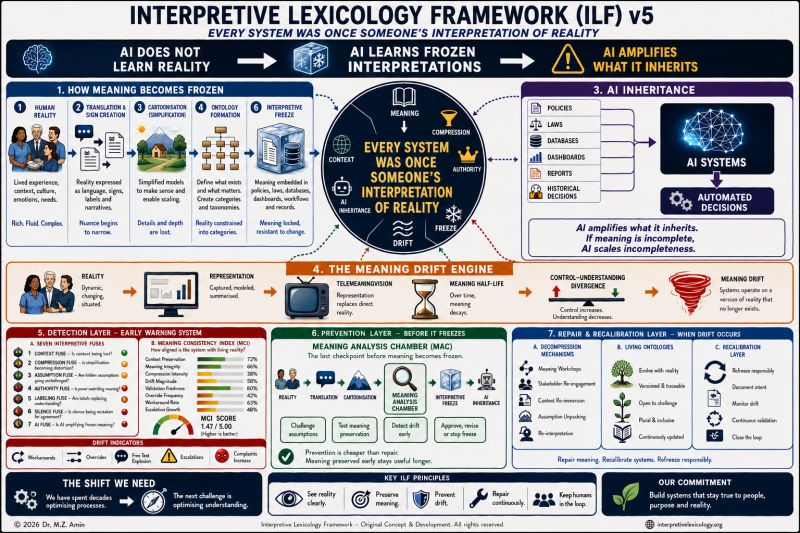
Understanding Meaning in Systems: The Interpretive Lexicology Framework
What People Say About the Interpretive Lexicology Framework
Frequently Asked Questions About the Interpretive Lexicology Framework
What is the Interpretive Lexicology Framework (ILF)?
The Interpretive Lexicology Framework (ILF) is a structured approach to understanding how meaning is created and transformed as it travels through human and technological systems. It investigates how interpretations of reality become frozen within various systems, impacting decision-making and outcomes.
Who can benefit from using ILF?
The Interpretive Lexicology Framework (ILF) was developed to help individuals, organisations, and technologies understand how meaning is created, translated, formalised, and sometimes distorted as it moves through systems.
Because every system is built upon interpretation, ILF has applications across almost every domain where decisions are made.
Healthcare Professionals
Doctors, nurses, therapists, managers, and healthcare leaders can use ILF to identify situations where policies, pathways, metrics, or electronic patient records no longer reflect frontline reality.
ILF helps organisations ask:
Are our processes still aligned with patient needs?
Are staff creating workarounds because reality has changed?
What signals suggest meaning drift before patient safety is affected?
Healthcare systems often fail gradually before they fail visibly. ILF provides a framework for detecting those early signals.
Information Technology Professionals
IT teams spend much of their time translating human needs into technological solutions.
ILF helps IT professionals understand:
Why users resist systems that appear technically correct.
How requirements become distorted through multiple layers of interpretation.
Why support tickets often reveal deeper organisational meaning failures.
How technology can amplify outdated assumptions.
For IT professionals, ILF provides a bridge between technical implementation and human reality.
Artificial Intelligence Developers and Researchers
AI systems learn from historical data rather than reality itself.
ILF provides a framework for understanding:
AI bias beyond traditional fairness discussions.
AI inheritance of frozen organisational assumptions.
The risks of scaling outdated interpretations.
How meaning degradation can occur across training data, labels, and models.
As AI becomes increasingly influential in decision-making, understanding inherited meaning becomes critical.
Business Leaders and Executives
Leaders often rely on dashboards, reports, KPIs, and performance metrics.
ILF encourages leaders to ask:
What reality is represented by these metrics?
What reality might be missing?
Are we measuring what matters or merely what is measurable?
Has organisational meaning drifted from organisational purpose?
The framework helps leaders move beyond performance measurement toward meaning validation.
Policy Makers and Government Organisations
Policies are frozen interpretations of social reality.
ILF helps policymakers examine:
Whether legislation still reflects current conditions.
How assumptions become embedded within regulations.
Why unintended consequences emerge over time.
How systems become disconnected from the communities they serve.
The framework provides tools for continuous interpretive review rather than periodic policy revision alone.
Educators and Researchers
Education and research are fundamentally concerned with knowledge creation and communication.
ILF supports:
Critical thinking.
Knowledge translation.
Meaning analysis.
Interdisciplinary research.
Understanding how concepts evolve over time.
Researchers can use ILF to examine how knowledge becomes institutionalised and how assumptions influence future understanding.
Neurodiverse Professionals
Many neurodiverse individuals naturally question assumptions, challenge categories, and notice patterns that others overlook.
ILF provides language for experiences often reported by:
Dyslexic thinkers.
ADHD thinkers.
Autistic thinkers.
Systems thinkers.
Pattern recognisers.
Rather than viewing difference solely as a deficit, ILF explores how alternative cognitive perspectives can function as early-warning systems for meaning drift.
Change Managers and Transformation Teams
Many transformation programmes focus on technology, processes, and structures.
ILF adds a missing dimension:
Meaning.
The framework helps organisations examine:
Whether change initiatives remain connected to frontline reality.
How meaning changes during transformation.
Why stakeholder resistance may reflect interpretation rather than opposition.
Society as a Whole
Perhaps the greatest beneficiaries of ILF are citizens living in increasingly complex technological societies.
Every day we interact with:
Algorithms.
Databases.
Policies.
Laws.
AI systems.
Organisational procedures.
Understanding that these systems are not reality itself—but interpretations of reality—helps people engage more critically with the institutions that shape their lives.
The Universal Beneficiary
Ultimately, ILF benefits anyone responsible for making decisions, designing systems, interpreting information, or understanding human experience.
Because every decision begins with an interpretation.
And every interpretation carries the possibility of drift.
The purpose of ILF is not to eliminate interpretation.
The purpose of ILF is to make interpretation visible.
Only then can systems remain connected to the realities they were created to serve
How does the ILF process work?
ILF guides users through examining the lifecycle of meaning within systems, emphasizing the gap between fluid reality and fixed interpretations. By understanding this relationship, organizations can adapt their systems to better reflect the evolving nature of reality.
What resources are available for learning about ILF?
We provide a variety of resources, including articles, case studies, and workshops that delve into the concepts and applications of ILF. Our website serves as a hub for ongoing education and updates.
Is there support available if I have questions about ILF?
Yes, we offer dedicated support for those interested in exploring ILF further. You can reach out through our contact page for personalized inquiries or assistance.
What kind of outcomes can I expect by applying ILF in my organization?
Organizations implementing ILF can expect improved decision-making processes, more accurate representations of reality within their systems, and enhanced adaptability to changing conditions, ultimately leading to better outcomes.
Where can I find pricing information for ILF training or resources?
Pricing details for our training programs and resources are available on our website. Please check the specific sections dedicated to educational offerings for comprehensive information.
Is there a guarantee that ILF will work for my organization?
While we cannot guarantee specific outcomes, we provide a comprehensive framework supported by research and case studies to assist you in navigating the complexities of system interpretations. Success depends on your commitment to applying the principles effectively.